

TLDR: A B2B digital marketing plan for 2027 should include six core elements: a clearly defined business objective, a specific audience, the right digital channels, a focused message, purposeful content and measurable outcomes.
These elements should work together rather than operating as separate marketing activities.
Planning your B2B digital marketing approach shouldn’t begin with, “What should we post on LinkedIn next year?” Instead, it should begin with a much bigger question: What does the business need marketing to achieve in 2027?
A successful strategy should connect business objectives to a clear audience, a focused message, the right channels, useful content and measurable outcomes.
In other words: it’s not simply telling your team what to post, where to advertise or how often to send an email. It should show how digital marketing will help the business create awareness, generate demand, support sales conversations and contribute to commercial growth.
Digital marketing gives businesses access to more channels, more targeting options and more data than ever before. But having more options doesn’t automatically make digital marketing more effective.
Before planning next year’s activity, start with one essential question:
Did your 2026 digital marketing plan deliver the outcomes the business needed?
The quickest way to create a stronger marketing plan is to understand what worked and what didn’t.
Many B2B businesses can point to activity like number of posts published, emails sent, website traffic, followers gained, impressions or which post performed best. But activity alone doesn’t show whether marketing supported the wider business. Those numbers can be useful, but only when they’re connected to what you were actually trying to achieve.
- Go back to your original business and marketing objectives… if the objective was lead generation, for example, look at how many relevant enquiries did digital marketing generate?
- If the objective was getting potential customers to engage with your product range, look at how many catalogue downloads, product-page visits or product enquiries did you generate?
- If you were trying to build awareness in a new market, ask did you reach the right companies, industries, job functions or geographic areas?
The point is not to punish underperforming activity. The point is to understand it.
“What you measure gets managed. But what you measure also needs to matter.”
A report containing millions of impressions might look impressive, but if the business objective was to generate qualified sales enquiries and none arrived, those impressions aren’t the whole story.
Why did your B2B marketing perform, or underperform, in 2026?
Once you’ve established what happened, don’t stop at the numbers. Understanding why something performed well (or not) is far more useful. Was it the audience, message, creative, channel, offer or customer journey?
Perhaps a campaign generated excellent engagement but very few enquiries. Maybe the creative attracted attention, but the call to action wasn’t strong enough. Your targeting reached the right industry, but the wrong people within those businesses. You could track people clicking through to your website, but could they easily find the technical information they needed. Or perhaps the campaign did exactly what it was designed to do, but the expectation was unrealistic.
Not every marketing activity should be judged against an immediate sale.
“An awareness campaign, technical product video, employee advocacy programme and lead-generation campaign play very different roles. They therefore need different measures of success.”
The question isn’t simply “Did this perform?” It’s “Did this perform the job we designed it to do?”
What business objectives should your 2027 B2B marketing plan support?
Now you can start planning forward. Every marketing plan should begin with the business objective first, before deciding on which platforms audiences, or even the content or campaign idea.
If you start with “We need to do LinkedIn. We need more social media posts. We should run Google Ads. We need a new newsletter.” you run the risk of expelling time, money, and resources on projects and campaigns with very little yield.
Instead, clarify what the business needs to achieve, for example:
- Increase qualified sales enquiries.
- Enter a new market.
- Grow a particular product category.
- Increase awareness amongst a specific group of decision-makers.
- Support distributors or channel partners.
- Increase online sales.
- Generate product trials or demonstrations.
- Recruit scarce skills.
- Strengthen employer branding.
- Improve customer education or technical support.
“Once the objective is clear, the marketing plan can identify the strategy, audience, message, content and channels required to achieve it.”
This is where digital marketing stops being a communications function operating in isolation and becomes a strategic business tool making marketing much easier to explain to management.
How should you measure your B2B digital marketing objectives?
Once you’ve established the objective, make it measurable. Your plan should state what success looks like in practical terms.
Imagine the business says: “We need more people to know about our industrial product range.” That’s a fair and typical business need, but how do you make this a measurable marketing objective?
The goal does not have to be perfect on day one. However, it must be specific enough to guide decisions and support reporting.
A strong B2B digital marketing objective includes:
- A business outcome.
- A defined audience or market.
- A realistic timeframe.
- A measurement method (impressions, reach, clicks, views, enquiries, etc.)
- A clear link to sales or operational priorities.
“This is how social and digital move from a communications function to a strategic business tool.”
Starting with the objective then define who you need to reach. Your audience then shapes the message. That message guides the content you create. The audience and content inform the most effective channels to use. Finally, the original objective sets out what success should be measured against.
What should a B2B digital marketing plan include?
At Social Media 101, we find it useful to think about digital strategy as a connected flow:
Business objective → Audience → Channel → Message → Content → Measurement
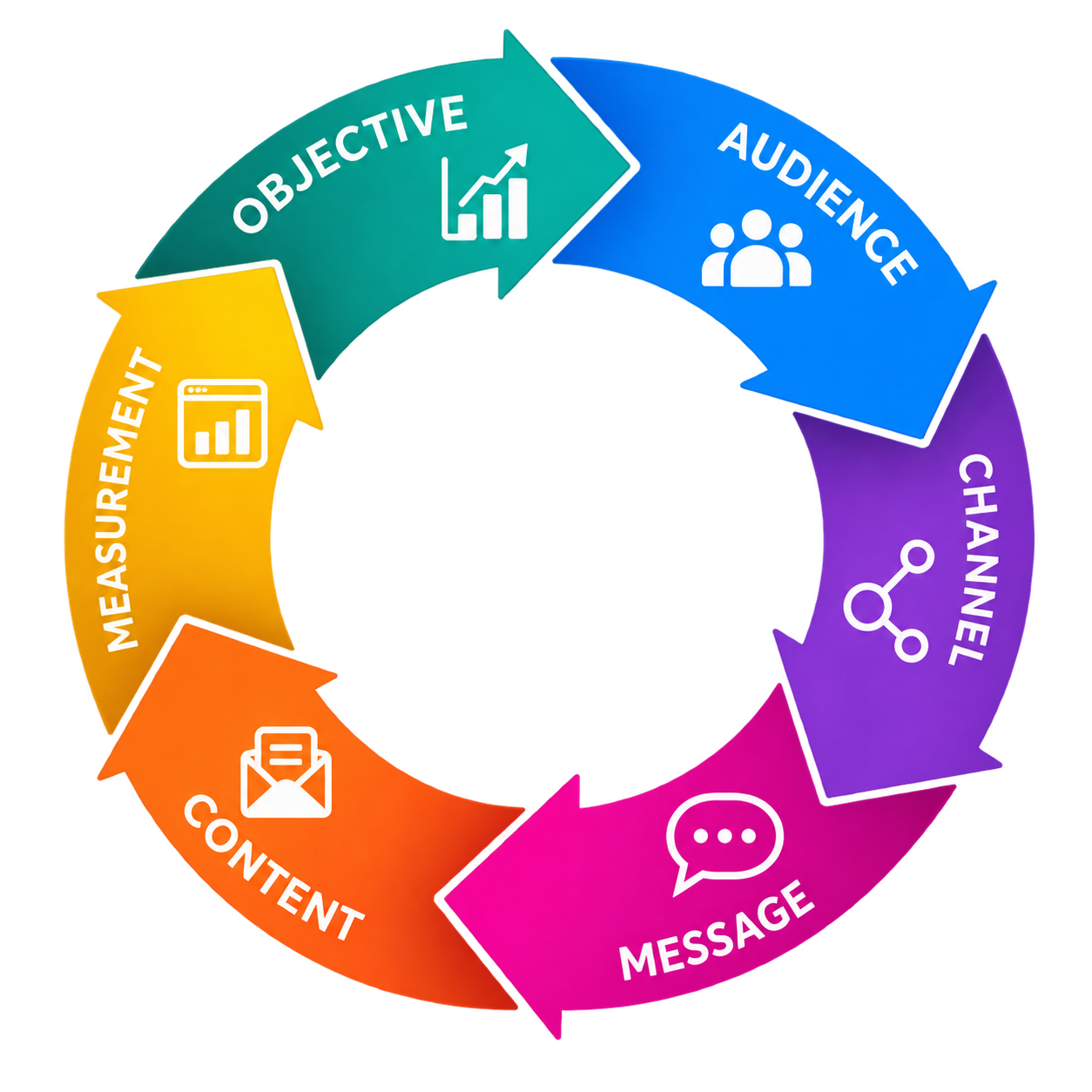
Each decision should inform the next.
Objective: What are we trying to achieve?
Start with the business outcome.
Audience: Who do we need to reach?
In B2B marketing this might include defining industry, company size, geographic market, job function, seniority, buying role, technical need or stage in the buying process. And remember that a B2B buying decision rarely involves only one person. The person researching your product may not be the person approving the purchase.
Channel: Where can we reach that audience?
LinkedIn may be important. But your digital ecosystem could also include Google Search, YouTube, email marketing, industry publications, your website, remarketing, webinars, eLearning platforms or other channels. Don’t choose a platform simply because your business has always used it. Choose it because it has a defined role in achieving the objective.
Message: What do we need them to believe or understand?
This is where many B2B campaigns become too product-focused. Your customer doesn’t necessarily need another list of product features. The message should answer the customer’s question, not simply repeat the company’s sales brochure.
Content: What will make the message credible?
Once you understand the objective, audience, channel and message, content creation becomes much more purposeful. That could mean technical articles, videos, case studies, product demonstrations, downloadable catalogues, webinars, social content, customer stories, email campaigns or sales-enablement material. Content is not the strategy. Content is what brings the strategy to life.
Measurement: How will we know if it worked?
Finally, decide what you’re going to measure before the campaign starts. Depending on the objective, that could include:
- Qualified enquiries
- Callback requests
- Catalogue or brochure downloads
- Demo bookings
- Webinar registrations
- Website conversions
- Online purchases
- Email sign-ups
- Target-account engagement
- Video completion
- Reach amongst a defined audience
- Cost per lead
- Conversion rate
- Revenue influenced by marketing
Digital marketing gives businesses an enormous advantage here. Almost every meaningful interaction can leave a measurable signal. The challenge isn’t finding more data. It’s deciding which data matters.
What does this look like in practice?
Imagine an industrial manufacturer wants to grow sales of a particular product category in Southern Africa.
Business objective: Grow the product category.
Audience: Procurement managers, engineers and technical decision-makers in target industries.
Channel: Paid LinkedIn, Google Search, industry media, email and website content.
Message: Demonstrate why the product solves a specific operational problem.
Content: Technical video, application article, case study, product page and downloadable technical information.
Measurement: Engagement from target audiences, technical-content consumption, catalogue downloads, callback requests and qualified sales enquiries.
The bottom line: What should your 2027 B2B digital marketing plan ultimately achieve?
A B2B digital marketing plan for 2027 should be more than a calendar of posts, emails and adverts.
It should be a connected system that starts with a business objective, understands the audience, delivers a relevant message through the right channels and measures meaningful outcomes.
When every activity links back to a clear purpose, marketing becomes easier to manage, easier to justify and far more likely to support growth.
Planning your B2B digital marketing strategy for 2027?
If you’re starting your 2027 brand or marketing planning and aren’t sure how digital should support your business objectives, Social Media 101 can help you build a strategy around the outcomes you’re actually trying to achieve.
REQUEST A CALLBACK