
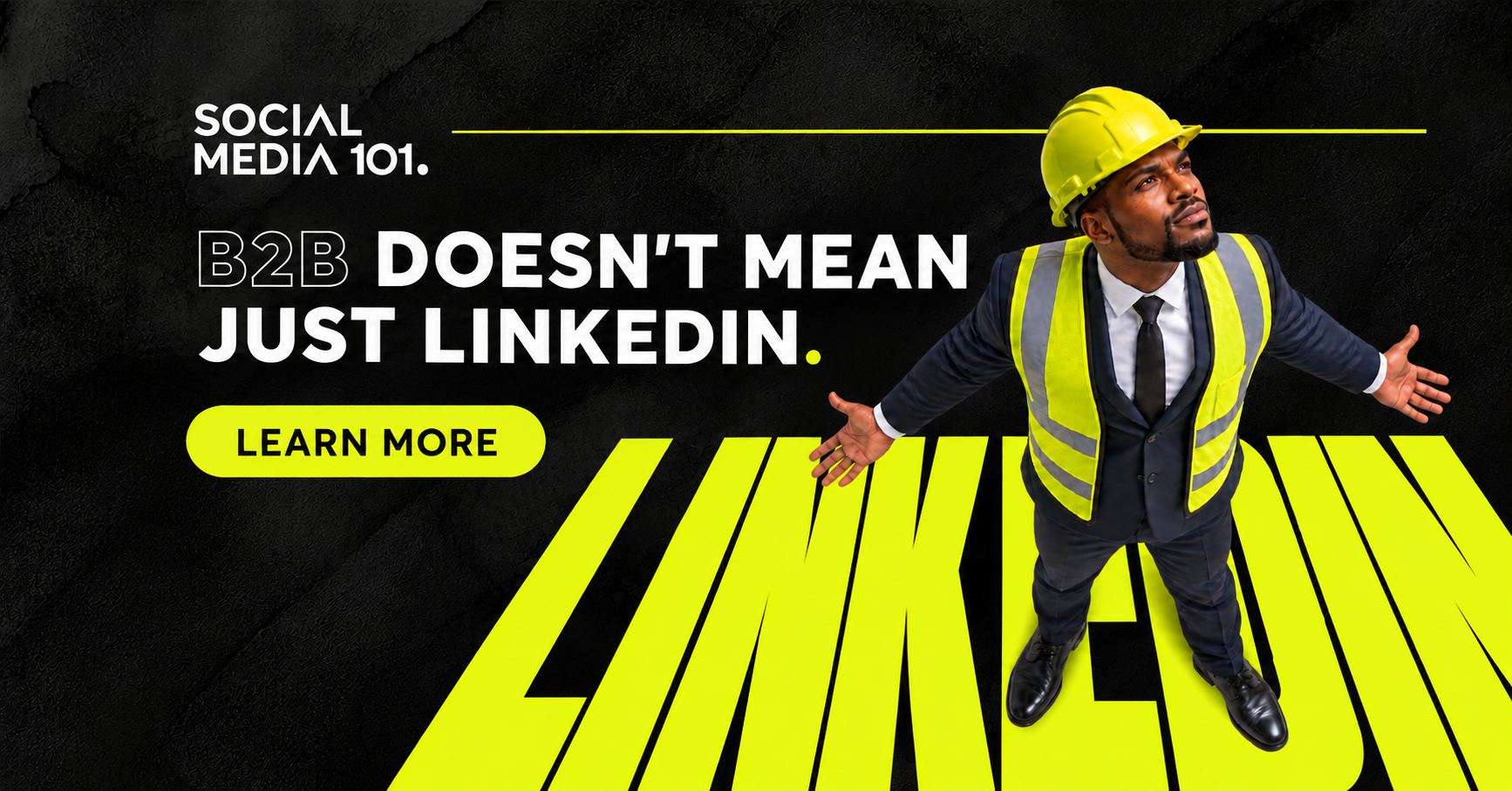
TLDR: The right digital channels for a B2B marketing strategy in 2027 depend on your business objectives, audience and how your customers discover, research, evaluate and buy. Your strategy may include your website, social media, video, email and AI search, but you don’t need to use every channel. Each channel should have a defined role in helping the business reach, educate, influence or convert the people who matter.
“Which platforms should we be on in 2027?”
It sounds like a sensible question, but a digital channel is a tool and so the first question is what job you need that tool to do.
A marketing strategy does not need to put your business on every digital platform. It needs to put the right information in the places your buyers are, at the moments they need it.
Much like a B2B digital strategy shouldn’t be a checklist of platforms, it should be a connected ecosystem that helps the business become visible, get found, educate its market, reach the right people and move potential customers towards action, and different channels can perform very different jobs within that ecosystem.
How should a B2B business choose its digital marketing channels?
Choose digital channels according to your business objective, the audience you need to influence and the behaviour you need to support. A channel belongs in the strategy because it performs a specific job, not simply because it is traditionally considered a B2B platform.
Many B2B businesses begin with LinkedIn because it is a professional network. It may well belong in the plan, particularly when you need to reach people by company or professional role. LinkedIn offers targeting based on attributes such as company and job experience, as well as options to reconnect with people who have previously engaged with your business.
But your buyers do not stop being buyers when they leave LinkedIn.
“Being a B2B business does not mean every buyer uses only “B2B platforms.” It means you need to understand which channel suits the buyer’s mindset and your message.”
What role does each digital channel play in the B2B buying journey?
The internet used to work something like this: Need → Google → Website → Decision
Today, the journey is far less linear…
Imagine a business has a problem with an existing product or supplier and needs to investigate alternatives. The same person might move through several digital environments as they work out what they need, which options exist and who they should eventually speak to.
What they’re looking for changes along the way.
TikTok: Discovery and education
“Why does [this problem] keep happening in our application?”
They may not even know what solution they need yet. They want a quick explanation, demonstration or useful piece of information that helps them understand the problem.
Instagram or Facebook: Awareness and inspiration
They encounter a sponsored post from a supplier demonstrating a solution to the exact problem they’ve been experiencing.
They weren’t searching for the company (or necessarily even for a solution) but the message is relevant enough to make them take notice.
YouTube: Evaluation and research
“How does [Solution A] compare with [Solution B]?”
Now they’re prepared to invest more time. They want a demonstration, technical explanation, application example or detailed comparison.
LinkedIn: Professional validation.
They see an engineer from one of the potential suppliers explaining an application, find the company page, or look at who works there and what expertise the business has.
The company is no longer simply a product they’ve encountered. They’re evaluating the people, expertise and credibility behind it.
AI tools: Delegated research and recommendation
“We need a solution for [problem]. It needs to work in [environment], meet [requirements] and we’re considering A, B and C. What should we be looking at?”
Now they’re asking a system to pull together information, explain the options and help narrow the field.
Google: High-intent discovery and retrieval
“[Specific product/solution] supplier South Africa”
By this point, the search is much more specific. They know roughly what they want and they’re actively looking for somewhere to get it.
Your website: Validation and action.
Now they’ve found you.
Can they immediately understand whether you provide what they need? Can they find the product, technical information, application, case study or proof they’re looking for? And can they easily take the next step?
These roles aren’t fixed. Buyers may use the same platform in different ways, but thinking about the intent behind each interaction helps businesses choose channels more strategically.
“The platforms aren’t merely different channels where businesses can distribute the same content, they’re different environments people use at different stages of understanding and decision-making.”
So instead of asking “Which platforms should our business be on?”
A more useful question is: “Where does our customer go for discovery, education, validation, comparison, recommendation and action?”
That gives you a much stronger basis for deciding which digital channels actually deserve a place in your strategy.
How is AI changing B2B search and discovery?
AI is changing B2B discovery by allowing buyers to ask detailed questions, compare options and receive synthesised recommendations without following the traditional search-engine journey of entering a keyword and visiting multiple websites.
People increasingly use AI tools to ask questions they may previously have typed into a search engine.
“Instead of searching several phrases and opening ten tabs, they can ask a detailed question and receive a synthesised answer. That changes the discovery environment.”
It means businesses need to think beyond simply ranking a webpage for a keyword. Can search engines and AI systems understand:
- What your business does?
- Which products and services you offer?
- Which industries you serve?
- Which problems you solve?
- Where you operate?
- What expertise you have?
- What evidence supports your claims?
- Why your information should be trusted?
This is where your website, product pages, service pages, FAQs, case studies and articles become strategically important.
Your blog isn’t just somewhere to put company news. A useful B2B blog should answer the questions your market is actually asking and demonstrate the experience, expertise and evidence that make your business a credible source of those answers.
How do you make sure your content reaches the right audience?
A website full of useful information cannot help buyers who never find it. Likewise, a well-made product video has limited commercial value if it never reaches the people it was created for.
“An always-on paid media strategy gives your business a consistent route to relevant audiences between launches, exhibitions and short campaign bursts.”
It means businesses need to think beyond simply ranking a webpage for a keyword. Can search engines and AI systems understand:
- What your business does?
- Which products and services you offer?
- Which industries you serve?
- Which problems you solve?
- Where you operate?
- What expertise you have?
- What evidence supports your claims?
- Why your information should be trusted?
This is where your website, product pages, service pages, FAQs, case studies and articles become strategically important.
Your blog isn’t just somewhere to put company news. A useful B2B blog should answer the questions your market is actually asking and demonstrate the experience, expertise and evidence that make your business a credible source of those answers.
Always-on does not mean running the same advert indefinitely. It means maintaining a planned level of visibility while refreshing messages, testing creative and adjusting spend as priorities change.
This gives channels connected roles: Paid media creates visibility → content builds understanding → the website supports evaluation → sales follows up on relevant interest.
Does a business need to be on every digital channel?
No.
In fact, trying to do everything at once can be one of the fastest ways to do everything badly.
A business with limited resources may get far more value from a strong website, useful search content and two well-managed paid channels than from maintaining seven social profiles, a neglected YouTube channel, a half-built online store and a chatbot nobody uses.
“Start with your strongest opportunities, get the fundamentals working, measure what happens, then expand.”
A mature digital ecosystem can eventually include multiple interconnected channels, but complexity should come after capability.
So which digital channels should be in your 2027 B2B marketing strategy?
Don’t start with a platform list. Start with the jobs that need to be done. Consider these aspects as part of your marketing plan and what you are trying to achieve:
| If the business needs to… | Consider… |
|---|---|
| Be found when someone is actively searching | Search, SEO and useful website content |
| Reach defined audiences before they’re looking for you | Targeted paid social media |
| Explain complex products or problems | Video, articles, webinars and e-learning |
| Generate enquiries or leads | Paid campaigns, landing pages and conversion-focused website experiences |
| Support sales conversations | Case studies, technical content, email, remarketing and sales-enablement content |
| Make purchasing easier | E-commerce or digital self-service tools |
| Amplify internal expertise | Employee advocacy and expert-led content |
| Maintain visibility during long buying cycles | Always-on paid media, remarketing and email |
| Become discoverable through AI | Useful expert content, clear product/service information, case studies, FAQs and authoritative website content |
Your strategy may eventually include all of them. It doesn’t need to start there.
The bottom line…
It’s the one where every channel has a clear reason to exist and supports how your customers discover, research, evaluate and buy from your business.
At Social Media 101, we think about this as a connected process:
Objective → Audience → Behaviour → Message → Channel → Content → Measurement
Objective: What does the business need to achieve?
Audience: Who do we need to influence?
Behaviour: How do they research, evaluate and make decisions?
Message: What do they need to understand or believe?
Channel: Where can we reach them?
Content: What information, proof or story will communicate that message?
Measurement: How will we know whether it worked?
Each decision should inform the next. Once you understand what the business needs to achieve, who you need to influence and how those people look for information, it becomes much easier to determine which channels deserve a place in your strategy.
The question for 2027 isn’t about which platforms should we be on. It’s which digital channels can do the jobs our business actually needs done.
Planning your 2027 B2B digital marketing strategy?
Social Media 101 helps businesses build connected digital ecosystems around commercial objectives, customer behaviour and measurable outcomes – rather than simply trying to be everywhere.
If you’re deciding where to focus your digital marketing investment in 2027, let’s build a strategy around the channels that can actually support your business objectives.
REQUEST A CALLBACK